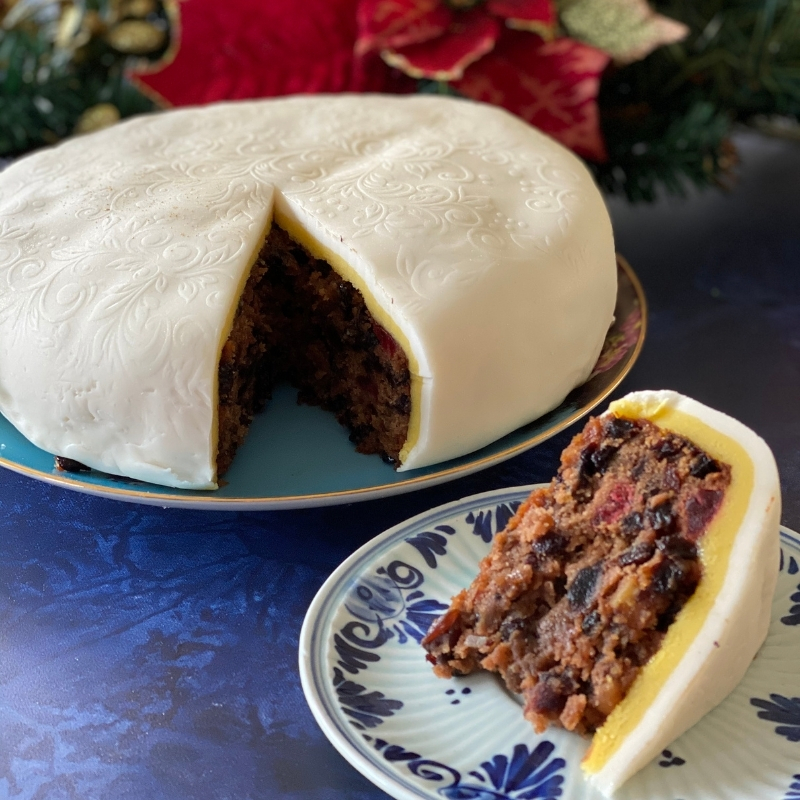
Traditional British Christmas Cake
Servings 20 or more servings
An Old Fashioned British Christmas Cake recipe full of fruit, rum and spice, with marizipan and fondant icing. A timeless festive classic.
Ingredients
- 1 pound currants
- 6 ounces sultanas
- 4 ounces raisins
- 4 ounces mixed peel also known as candied peel, this is widely available in the UK and Europe and available in the baking aisles of some North American grocery stores
- 4 ounces glacé cherries not maraschino cherries, halved
- ¾ cup dark rum or sherry original recipe calls for 1 tablespoon
- 1 ounce almonds, chopped
- 1 ounce ground almonds ground almonds are also known as almond flour
- 9 ounces plain flour plain flour is also known as all purpose flour
- 2 level teaspoons cocoa
- 1 level teaspoon salt
- 1 level teaspoon baking powder
- 2 level teaspoons mixed spice
- 9 ounces butter, softened plus extra for greasing the cake tin
- 4 eggs
- 9 ounces soft brown sugar
- finely grated rind of 1 lemon
- 1 teaspoon coffee essence this is optional
- For the Almond Icing If you prefer you can use ready made Marzipan, available in most grocery stores
- 8 ounces ground almonds ground almonds are also known as almond flour
- 4 ounces caster sugar caster sugar is also known as superfine sugar
- 5 ounces sifted icing sugar icing sugar is also known as confectioner’s sugar
- 2 ounces butter
- 2 egg yolks (reserve the whites for the Royal icing)
- 1 teaspoon lemon juice
- 3 to 4 tablespoons sieved apricot jam to make the almond icing stick
- For the Royal Icing You can also use ready made fondant to cover the cake as I do if you prefer.
- 4 egg whites
- 1½ pounds sifted icing sugar
- 1 teaspoon lemon juice
- 1 teaspoon glycerine available from some supermarkets, pharmacies & cake supply stores
Instructions
- Mix the currants, sultanas, raisins, mixed peel and glacé cherries together and pour the rum over top. Cover and set aside for a few hours or overnight. If there is a large amount of rum in the bottom of the bowl or pan when you go to make the cake, drain a bit of it off, but if there are only a couple of tablespoons you can safely leave it. (Conversely, if the fruit soaks up all of the rum, you can add a tablespoon or so more. However in this case, pour off any that does not soak in before you start actually making the cake.)
- To make the cake, preheat the oven to 325°F (165°C or 150°C for fan ovens).
- Grease an 8 to 10 inch (20 to 24 cm) in diameter, at least 2½ inches (6 to 7 cm) deep) cake pan with butter and line with baking parchment. (The smaller pan will cook more slowly as the cake will be thicker.) My favourite pan is 10 inches in diameter. I like to use a springform pan as it makes the cake easier to remove from the pan.
- Mix the soaked dried fruit with the chopped and ground almonds. Set aside.
- Sift the flour, cocoa, salt, baking powder and mixed spice together..
- In a separate bowl, cream the butter and brown sugar.
- Add the lemon rind.
- Add the eggs, one at a time, with a tablespoon of the flour mixture for each, beating after each addition.
- Fold in the remaining flour mixture, the coffee essence (if using) and then the dried fruit and nuts.
- Turn the mixture into the prepared cake pan and smooth over the surface, making a slight hollow in the centre with a soup spoon. This helps the Christmas cake to rise evenly.
- Bake at 325ºF (160ºC or 150ºC for a fan oven) for 45 minutes, and then reduce the temperature to 300ºF (150ºC or 140ºC for a fan oven) for a further 40 to 60 minutes or until a skewer inserted in the centre of the cake comes out clean. Do keep an eye on the cake while it is baking as oven temperatures do vary radically and you don't want it to burn. Equally you do not want the cake under-cooked, so be sure that the skewer is coming out clean from the centre of the cake. That is when it is done, regardless of baking time.
- Cool the cake in the pan for at least an hour and then carefully remove it to cool on a wire rack.
- After the cake is completely cook you can wrap it in foil or store it in a sealed cake tin. If you are making it well ahead of time, you can keep it in a cool dry place for six to eight weeks, feeding it once a week with a bit more rum. Of course, if you make the cake closer to the time you want to serve it, you can still 'feed' it in this way once a week until you cover it with marzipan.
- A day or so before serving, we traditionally cover our Christmas cakes with marzipan and royal icing or fondant. You can use store bought marzipan, royal icing and fondant if you prefer ( I always do!) but Nana's traditional recipes for marzipan and royal icing follow.
- To make the marzipan from scratch, mix the ground almonds, sugar and icing sugar together.
- Rub or cut the butter into this mixture until it looks like coarse breadcrumbs.
- Mix the egg yolks and lemon juice and add them to this mixture.
- Work the paste to a stiff but pliable consistency, adding a bit more lemon juice if it seems dry.
- Divide the almond paste in half.
- Using a light dusting of corn flour (corn starch) to prevent sticking, roll the first half into a circle that will cover the top of the cake.
- Brush the top and sides of the cake with the sieved apricot jam, and apply the circle to the top of the cake, pressing firmly.
- Using your hands, roll the second half of the almond paste into a long roll and then flatten it as evenly as you can with a rolling pin. This piece needs to be wide enough to cover the sides of the cake.
- Press the flattened roll along the sides of the cake, pressing firmly and sealing the joins between the top and sides with your fingers.
- Leave the cake in a cool airy place for several hours so the almond paste can dry out a bit.
- To make the royal icing, beat the egg whites lightly.
- Add the lemon juice and glycerine.
- Beat in enough icing sugar to make a thick coating consistency that rolls easily off a wooden spoon, but leaves it coated.
- Place the marzipan topped cake on a piece of greaseproof or waxed paper. Have a palette knife to hand to help guide the icing. Pour the icing bit by bit over the top of the cake, spreading it with the knife. Let it find its way down the sides, guiding it with the knife until the cake is completely covered. Leave the cake in a cool airy place overnight, or until the icing has set.
did you make this recipe?
Make sure to tag #apriljharris on Instagram and follow @apriljharris for more.